Let me start by saying this: nothing, absolutely nothing, prepares you for your first 6000m summit. Not the months of jogging in the park, not your shiny new trekking poles, and definitely not the overconfidence that came free with your gym membership.
When I signed up for Kang Yatse II, I had this cinematic vision of myself , conquering peaks, raising my ice axe, glistening sunrise behind me, wind whipping my hair like a Bollywood hero. Reality, as it turned out, had other plans.
Phase 1: The Overconfidence Before Base Camp
The journey began like every expedition , with way too much excitement and way too little altitude awareness. At Leh, I strutted around like a seasoned mountaineer, dropping words like “acclimatization” and “ascent rate” in casual conversations just to sound cool. I even told someone I “like thin air” , which in hindsight was ironic considering how I would soon be gasping for it like a malfunctioning vacuum cleaner.
The drive to Markha Valley was jaw-dropping. Himalayas rising all around, yaks photobombing every shot, and me imagining my triumphant summit photo. Spoiler alert: I eventually looked more like a lost astronaut than a hero.
Phase 2: Base Camp , Where Dreams Meet Diarrhea
Base camp is where the mountain first tests your willpower… and your digestive system. One minute you’re sipping hot soup, the next you’re sprinting to the toilet tent, hoping your down jacket doesn’t freeze mid-run.
Everyone suddenly becomes a philosopher. Phrases like “the mountain humbles you” and “altitude is an illusion” start floating around. No one tells you about the altitude headaches that feel like your skull is shrinking or how the sleeping bag becomes your best (and only) friend.
But spirits are high , partly because there’s no Wi-Fi, so no one can Google how dangerous 6000m actually is.
Phase 3: The Summit Push , Oxygen? Never Heard of Her
Summit night starts at 1 AM. Because apparently, the best time to do something extremely dangerous is in total darkness with numb fingers.
You start climbing slowly, step by shaky step. It’s minus what-feels-like-forever-degrees, your breath freezes on your balaclava, and your brain starts negotiating with your legs:
“Come on, just five more minutes and we’ll turn back.”
“No we won’t.”
“Shut up.”
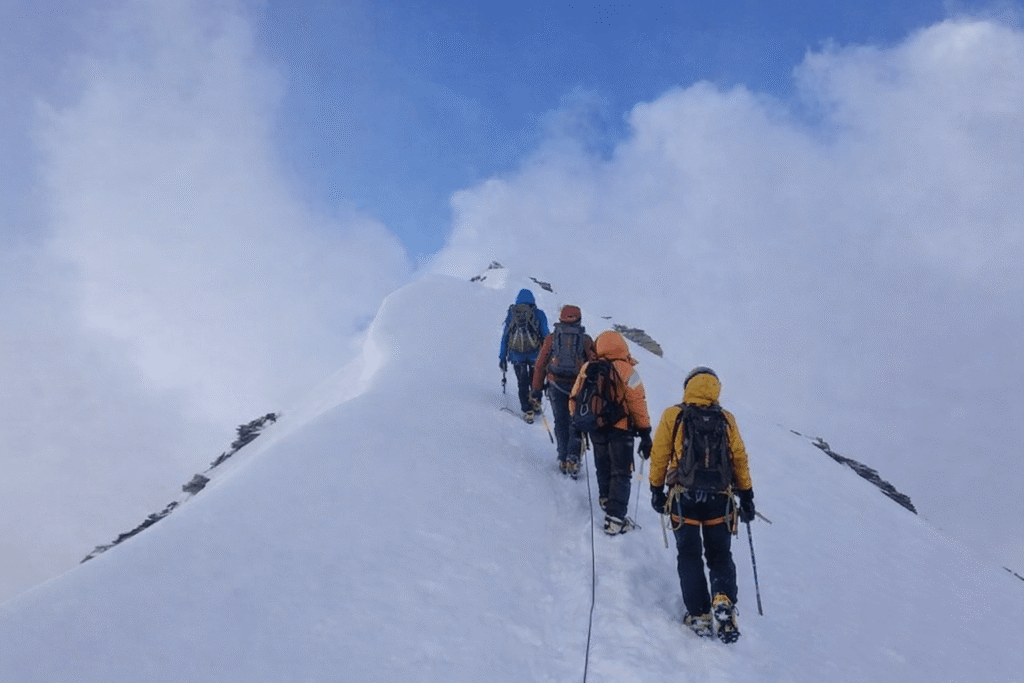
At around 5800m, even thinking feels like hard labor. Every step feels like you’re dragging a small car uphill. Your headlamp creates this eerie tunnel vision, and all you can see are your boots, the snow, and your questionable life choices.
Then, suddenly , there it is. The summit ridge. The horizon starts to glow pink as the sun rises over the Himalayas. You forget the pain, the exhaustion, the 15 layers of thermals threatening to strangle you. You just stand there , frozen, breathless, but completely alive.
You didn’t just climb a mountain; you climbed your own limits.
Phase 4: The Descent , The Great Gravity Betrayal
Coming down sounds easy, right? Wrong. That’s when you discover muscles you didn’t know existed. Your knees start filing official complaints, your toes feel mutinous, and all you can think about is Maggi noodles and a bed that doesn’t slope at 45 degrees.
By the time you reach base camp, you’ve aged five years, burned 10,000 calories, and sworn you’ll never do this again.
Of course, two days later, while sipping chai in Leh, you’re already Googling your next 6000m expedition. Because apparently, high-altitude suffering is addictive.
Climbing Kang Yatse II isn’t just an adventure , it’s a comedy, a therapy session, and a crash course in humility all rolled into one. You go up as one person and come down with a new identity: Certified Survivor of Oxygen Deficiency.
And honestly? You wouldn’t trade that for anything.